 10% OFF
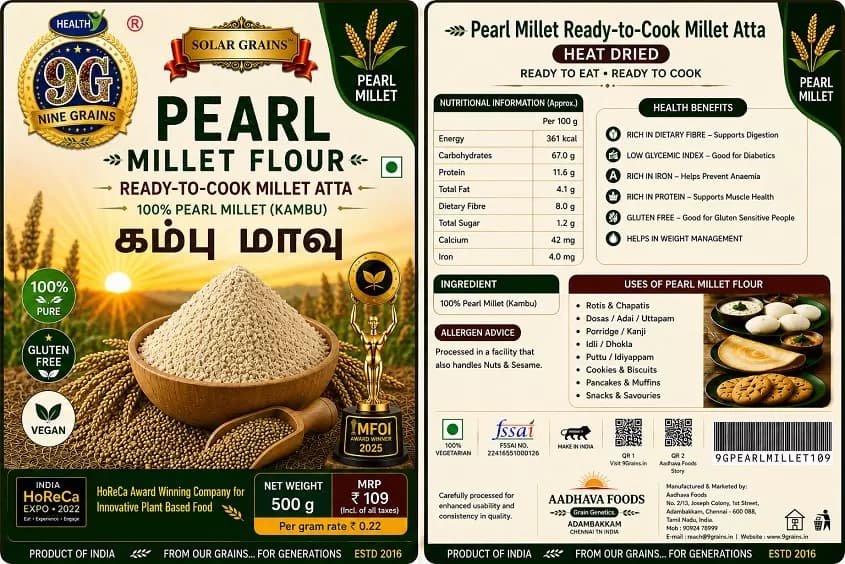
Pearl Millet Flour (Kambu Atta)
About this product
Traditional kambu/bajra atta. Cooling, iron-rich and energy-dense. Gluten-free. To be taken during Warm/ Hot Season. Avoid during Winter times.
FSSAI Certified
Lic. No. 22416551000126 · Food Safety & Standards Authority of India
Free Delivery
On orders ₹499+
7-Day Returns
Easy returns
Detailed Description
Pearl Millet, widely known as Bajra in Northern India and Kambu in Tamil Nadu, is a powerhouse ancient grain
highly valued in traditional Indian cooking. It serves as a climate-resilient, gluten-free superfood staple across
diverse regional cuisines.
Archaeological Evidence and Timelines
- ✓Earliest Dispersal: Recent radiocarbon dating indicates that pearl millet arrived on the Indian subcontinent much
- ✓earlier than previously assumed. Caryopses found at Bhando Qubo in the lower Indus Valley date back to 2578–2356 BCE,
- ✓showing that it spread from West Africa to India during the Mature Harappan phase.
- ✓Indus Valley & Late Harappan Era: Well-documented grains have been excavated from peripheral Harappan
- ✓ and Late Harappan sites (2000–1700 BCE) in Gujarat, including Rojdi, Kanmer, Oriyo Timbo, and Babar Kot.
- ✓ As the southwest monsoon weakened over time, ancient farmers strategically shifted to drought-resistant millets
- ✓ as a vital cultural adaptation to survive prolonged droughts.
- ✓Neolithic & Iron Age Expansion: Beyond the Indus region, ancient pearl millet seeds dating to the Neolithic and
- ✓Chalcolithic periods (2000–1200 BCE) have been discovered at the Hallur site in Karnataka, Kaothe in Maharashtra,
- ✓and within the Narhan culture of Uttar Pradesh.
- ✓
- ✓Textual and Historical Context
- ✓Sanskrit Nomenclature: In historical texts, pearl millet is typically identified by the Sanskrit terms Nali or Nala.
- ✓Literary Mentions: While indigenous millets like Shyamaka (barnyard) and Priyangu (foxtail) feature prominently
- ✓ in the oldest Vedic literature, pearl millet entered formal medical and dietary encyclopedias somewhat later.
- ✓It is formally classified under the Truna Dhanya (grain-bearing grasses) category in the 14th-century Ayurvedic
- ✓compendium, Madanapala Nighantu.
- ✓Agricultural Frameworks: Historical treatises like the Kautilya Arthashastra document the broader socioeconomic
- ✓value of millets, highlighting them as core crops within the state's ancient agricultural and taxation frameworks
Key Health Benefits
- ✓Diabetes Management: The complex carbohydrates release energy slowly. The presence of phenolic
- ✓compounds assists in regulating steady blood glucose levels.
- ✓Combats Anemia: Its notably high iron and folic acid profile aids in increasing hemoglobin. This makes it
- ✓highly recommended for pregnant women and individuals suffering from iron deficiency.
- ✓Celiac-Friendly Digestion: Being 100% gluten-free, it is an optimal alternate grain for individuals with
- ✓celiac disease or gluten sensitivity.
- ✓Heart Health & Hypertension: Packed with magnesium and potassium, it helps relax blood vessels,
- ✓ lower blood pressure, and manage overall cholesterol levels.
Traditional and Modern Culinary Uses
Indians leverage the versatile texture of pearl millet flour and whole grains across several savory preparations:
- ✓Flatbreads (Rotis/Chapatis): Pearl millet flour is extensively kneaded to produce Bajra Rotis in
- ✓Rajasthan and Gujarat, typically paired with ghee and jaggery.
- ✓Porridges & Gruels (Koozh/Kanjis): In Southern India, Kambu Koozh is prepared by fermenting
- ✓cooked pearl millet with buttermilk, small onions, and green chilies, serving as a popular cooling
- ✓breakfast during summers.
- ✓One-Pot Meals: The whole unpolished grains are mixed with split yellow lentils to make
- ✓comforting Bajra Khichdi.
- ✓Modern Snacks: Today, it is processed into Poha (flakes) for light breakfast dishes or baked into
- ✓fiber-rich cookies and crackers.
Processing significantly alters the mineral absorption of pearl millet by breaking down
nternal "anti-nutrients" that natively lock up its high iron, zinc, and calcium content. While raw pearl millets
dense with micronutrients, its minerals are chemically bound to phytic acid, tannins, and insoluble fibers
concentrated in the grain's outer layers.
Understanding how different domestic and industrial processing methods affect mineral
bioaccessibility reveals distinct outcomes:
1. Soaking (Activation)
- ✓The Effect: Immersing the grains in water triggers the activation of a natural, dormant grain
- ✓enzyme called phytase.
- ✓Absorption Impact: Activated phytase breaks down phytic acid into lower compounds. This stops it
- ✓ from binding to essential minerals in your gut. Research shows that simple acidic soaking
- ✓(such as adding a splash of lemon juice or curd water) can significantly lower phytic acid, markedly
- ✓ increasing the bioavailability of iron and zinc.
2. Germination (Sprouting)
- ✓The Effect: Sprouting "wakes up" the seed, initiating enzymatic de novo synthesis which
- ✓ further reduces anti-nutrients.
- ✓Absorption Impact: It is highly effective for mineral release. Studies published on NCBI PMC note
- ✓that malting and sprouting drop the phytate-to-mineral molar ratio significantly, leading to maximum
- ✓soluble and ionizable iron levels.
3. Fermentation
- ✓The Effect: Traditional preparation of Indian gruels like Kambu Koozh introduces beneficial lactic acid bacteria.
- ✓Absorption Impact: Microbial phytase heavily degrades phytic acid. The dropping pH level provides an
- ✓optimal environment for mineral solubility, turning a dense porridge into an easily absorbable tonic for the gut.
4. Decortication (Milling & Polishing)
- ✓The Effect: Mechanical pounding or industrial milling physically removes the outer bran and pericarp
- ✓ layer of the seed.
- ✓Absorption Impact: Because phytic acid is mostly concentrated in the bran, stripping it away lowers
- ✓ anti-nutrient levels. However, excessive polishing also strips away the primary minerals stored in the
- ✓ aleurone layer. Gentle, targeted decortication (removing only 10–15% of the outer hull) offers the
- ✓ perfect trade-off, achieving the highest mineral bioaccessibility without emptying the grain's nutrition.
5. Thermal Treatments (Roasting & Blanching)
- ✓The Effect: Exposing the flour to pre-heating, roasting, or boiling.
- ✓Absorption Impact: Heat partially inactivates heat-sensitive tannins and polyphenols. While it slightly
- ✓diminishes raw phytase activity, the thermal breakdown of the hard grain structure ensures remaining
- ✓ minerals are easily freed during digestion
Nutritional Profile (Per 100g)
According to authoritative data from sources like the Indian Institute of Millets Research (IIMR), the
approximate nutritional breakdown of raw pearl millet is:
- ✓Energy: ~360 kcal
- ✓Protein: 10.6 g – 11.6 g (highly beneficial for plant-based diets)
- ✓Dietary Fiber: 1.3 g – 1.6 g (with significant insoluble fractions)
- ✓Fat: 5.0 g (contains healthy lipids)
- ✓Carbohydrates: ~67.5 g (complex carbs with a low glycemic index)
- ✓Iron: ~6.4 mg – 8.0 mg
- ✓Calcium: ~27.4 mg – 38.0 mg
- ✓Phosphorus: ~242 mg
Customer Reviews
No reviews yet. Be the first to share your experience!
Please login to write a review. Only verified purchasers can submit reviews.