 10% OFF
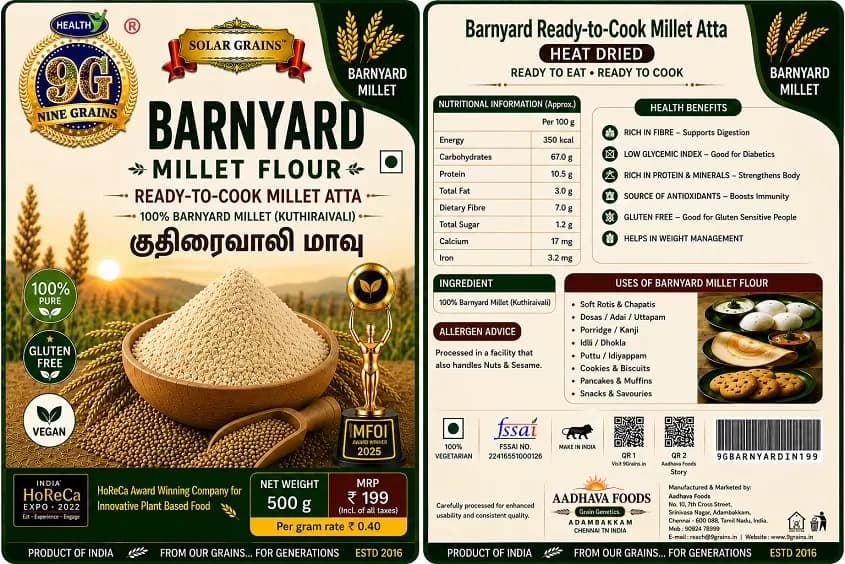
Barnyard Millet Flour (Kuthiraivali Maavu -Atta)
About this product
Kuthiraivali atta — highest fibre millet flour. Excellent for fasting and weight management.
FSSAI Certified
Lic. No. 22416551000126 · Food Safety & Standards Authority of India
Free Delivery
On orders ₹499+
7-Day Returns
Easy returns
Detailed Description
Barnyard millet flour (Sanwa / Bhagar) is a highly nutritious, gluten-free grain commonly consumed
during fasting periods in India and used as a healthy daily alternative to wheat.
Ancient Staples and Regional Diets
- ✓The Primary Carb Source: Before irrigation made water-heavy crops like white rice accessible,
- ✓barnyard millet was eaten daily as a direct substitute for rice, particularly in the hilly, arid, and tribal
- ✓ regions of Northern and Central India.
- ✓Himalayan Jhangora Culture: In the Uttarakhand region, Jhangora was an indispensable daily grain.
- ✓ The community traditionally prepared Madira ki Kheer (a sweet porridge) and regional gruels to sustain
- ✓energy in harsh mountain temperatures.
- ✓Southern Indian Fermentations: In southern regions, the grains were dehusked and integrated into
- ✓traditional early versions of everyday staples like Idli, Dosa, and Murukku long before modern
- ✓processing practices became common.
- ✓
Spiritual and Cultural Significance
- ✓Sacred Fasting Grain (Vrat / Upwas): Because it grows wild or with minimal human intervention,
- ✓early religious traditions categorized it as a "non-grain" or wild seed rather than an agriculturally
- ✓cultivated crop like wheat. This made it a vital ritualistic food for Hindu fasting days (Navratri, Ekadashi),
- ✓prepared into Samak Khichdi or Farali flatbreads to maintain energy during abstinences.
- ✓
Agronomic Security and Survival
- ✓Famine Insurance: Due to its short crop cycle (maturing in 45–60 days) and extreme drought resistance,
- ✓earlier farming communities heavily relied on it as a insurance crop against failed monsoons. It could sprout
- ✓even in poor soils or withstand sudden water logging, preventing localized starvations.
- ✓Dual-Purpose System: Historically, nothing went to waste. While humans consumed the small
- ✓ nutrient-dense grains, the highly palatable green straw served as an invaluable source of
- ✓high-quality cattle feed, hay, and silage during dry months
Key Health Values (Per 100g approx.)
- ✓High Dietary Fiber: Contains around 10–12% fiber, making it excellent for digestion and gut health.
- ✓Low Glycemic Index (GI): Slow-digesting carbohydrates help prevent sudden spikes in blood sugar.
- ✓Rich in Iron: Provides a substantial amount of dietary iron to help combat anemia.
- ✓Protein Content: Contains roughly 6–8% easily digestible protein.
- ✓Mineral-Rich: Good source of essential minerals like calcium, magnesium, and phosphorous.
- ✓
Health Benefits
- ✓Manages Blood Sugar: The low glycemic index and high fiber content help regulate glucose levels,
- ✓making it ideal for diabetic diets.
- ✓Aids Weight Loss: High fiber and complex carbs provide long-lasting satiety, reducing overall calorie intake.
- ✓Naturally Gluten-Free: A safe and healthy alternative for individuals with celiac disease or gluten intolerance.
- ✓Improves Heart Health: Dietary fiber helps lower bad cholesterol levels and supports overall
- ✓cardiovascular function.
- ✓Boosts Immunity: Packed with antioxidants that help fight cellular damage and strengthen
- ✓ body defense mechanisms.
- ✓
Culinary Uses
- ✓Fasting Delicacies: Widely used during Hindu fasting (Vrat/Upwas) to make Puris, Thalipeeth, and Halwa.
- ✓Breakfast Staples: Perfect for preparing nutritious, instant gluten-free Idlis, Dosas, and Uttapams.
- ✓Flatbreads: Can be mixed with lukewarm water to roll out healthy Rotis or Bhakhris.
- ✓Porridge & Gruel: Cooked with milk or water to make a comforting, easy-to-digest meal for children and recovering patients.
- ✓Thickening Agent: Works well as a gluten-free thickener for soups, stews, and gravies.
- ✓
In earlier times across India, barnyard millet (Echinochloa frumentacea) was one of the
oldest cultivated domesticated crops, dating back thousands of years as a staple food predating
modern rice and wheat. Known historically as Sawan, Sanwa, Jhangora, or Kuthiraivali, its
historical usage was deeply tied to subsistence farming, regional food security, and spiritual rituals.
Customer Reviews
No reviews yet. Be the first to share your experience!
Please login to write a review. Only verified purchasers can submit reviews.