 10% OFF
Small Millet Flour (Samai Maavu/Atta)
About this product
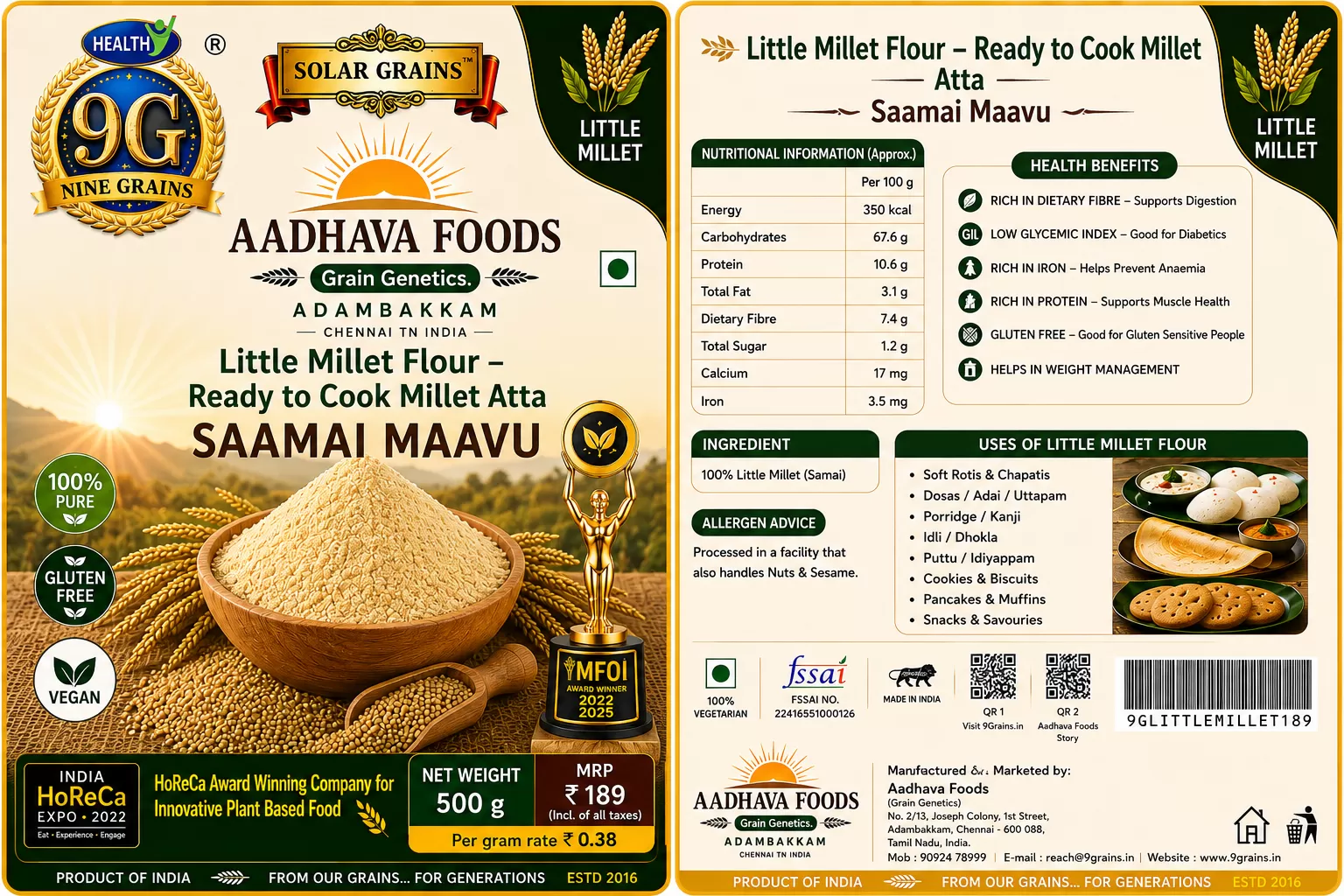
Samai / Little millet atta. High fibre (7.6g), low GI, gluten-free. 500g.
FSSAI Certified
Lic. No. 22416551000126 · Food Safety & Standards Authority of India
Free Delivery
On orders ₹499+
7-Day Returns
Easy returns
Detailed Description
Little Millet (Panicum sumatrense), commonly known as Kutki in Hindi or Samai in Tamil, is a nutritional powerhouse
that stands out among the millet family. While all millets offer immense health value over refined grains,
little millet holds a unique edge in texture, digestion, and mineral profile.
Supremacy Over Other Millets
- ✓Easiest to Digest: It features a finer structure and smaller grain size. This makes it significantly lighter on
- ✓the gut than denser millets like Finger Millet (Ragi) or Sorghum (Jowar).
- ✓Highest in Iron Content: It contains roughly 9.3 mg of iron per 100g. This value outperforms most major
- ✓millets and easily dwarfs refined rice or wheat.
- ✓Fastest Cooking Time: Little millet flour absorbs water uniformly and cooks rapidly. It lacks the coarse,
- ✓bitter aftertaste sometimes associated with Pearl Millet (Bajra).
- ✓Superb Weather Resilience: agriculturally, the crop can survive severe droughts and unexpected waterlogging.
- ✓ This outmatches the climate limits of other small millets.
Nature of Uses
Little millet flour is a highly adaptive, gluten-free culinary ingredient:
- ✓Daily Flatbreads: You can blend it with hot water to roll soft, gluten-free rotis, chapattis, or parathas.
- ✓Breakfast Staples: It serves as an excellent base for instant, gut-friendly porridges, savory upma, or chillas.
- ✓Fermented Batters: You can substitute rice with little millet flour to create healthy, low-glycemic dosa and idli batters.
- ✓Healthy Baking: Bakers often use it in a 1:1 ratio with alternative starches for nutrient-dense cookies, crackers,
- ✓ and gluten-free pancakes.
Health Benefits
- ✓Manages Blood Sugar: Its exceptionally low Glycemic Index (GI) slows glucose absorption, preventing insulin spikes.
- ✓Combats Anemia: Densely packed with bioavailable iron, regular consumption effectively treats fatigue and elevates hemoglobin levels.
- ✓Aids Weight Control: High concentrations of soluble dietary fiber induce long-lasting satiety and curb unhealthy cravings.
- ✓Enhances Gut Health: It operates as a natural prebiotic, promoting good stomach bacteria while relieving bloating and constipation.
- ✓Protects the Heart: It is naturally rich in magnesium and plant-based niacin (Vitamin B3). These elements actively regulate blood pressure and optimize cholesterol levels.
In Ancient India, Little Millet (Panicum sumatrense) was not just a substitute food; it was a primary indigenous staple that predates the widespread cultivation of modern rice and wheat. Domesticated right within the Indian peninsula, it served as a crucial foundation for prehistoric survival, early empires, and ancient medicinal systems.
Archaeological Findings (Indus Valley & Beyond)
- ✓The Harappan Staple: In Indus Valley Civilisation sites like Harappa and Farmana, archaeobotanists recovered massive
- ✓ assemblages of little millet. At Harappa, its cultivation peaked around 2600 BCE, accounting for roughly 5% of the total
- ✓recorded cereal remains.
- ✓The "Catch Crop" of Antiquity: Because little millet can mature in very short periods and withstand severe droughts
- ✓or unexpected floods, ancient Indian farmers relied heavily on it as a "catch crop". If a primary monsoon crop failed,
- ✓little millet was planted to prevent total famine.
- ✓Pre-Historic Tools: Across ancient excavations in Southern India, archaeological layers reveal charred millet grain
- ✓ paste stuck to ancient granite saddle querns (grinding stones). This indicates that transforming little millet into
- ✓flour to make early porridges or flatbreads dates back thousands of years.
- ✓
Mentions in Ancient Literary Texts
- ✓Vedic Literature: Grains from the wider minor millet family—often grouped historically under terms like
- ✓Shyamaka or Anu—appear frequently in the Yajurveda and the Samhitas. They were celebrated as sacred
- ✓grains grown purely by nature, free from the heavy processing required by later crops.
- ✓Kautilya’s Arthashastra: Written during the Mauryan Empire, this classical statecraft text explicitly
- ✓classifies small millets as highly essential state grains. The text tracks state granaries storing millets
- ✓ due to their incredibly long shelf life in grain form, acting as an ancient buffer against drought.
- ✓Early Sangam Poetry: Ancient Tamil texts from the early common era detail the daily culinary lifestyle
- ✓of hill and forest communities. The poems record tribes pounding small mountain millets like Samai into a
- ✓fine paste and cooking it down with milk, wild honey, or buttermilk.
Medical Roots in Ayurveda
In ancient Indian medical frameworks, little millet was thoroughly integrated into preventative healthcare.
Sage Charaka and Sage Sushruta classified minor millets under Kudhanya or Trina Dhanya (grain-bearing grasses).
Ayurvedic texts praised the grain for its Lahu (light/easy to digest) and Ruksha (drying) qualities.
It was specifically prescribed to balance Kapha and Pitta doshas, treat internal inflammation,
and serve as an ancient dietary remedy for metabolic sluggishness (what we describe today as diabetes).
Small Millet (Samai / Little Millet) flour is a gentle, easy-to-digest grain with a low glycemic index and excellent fibre content. Rich in iron and B vitamins, it is traditionally used in South Indian cooking for everything from porridge to festive kozhukattai.
Nutrition (per 100g):
- ✓Protein: 7.7g
- ✓Fibre: 7.6g — excellent gut health support
- ✓Mineral: 1.7g
- ✓Iron: 9.3mg — important for blood health
- ✓Calcium: 17mg
Ideal for: Samai rice, kozhukattai, rotis, idli batter, porridge, fasting recipes (vrat). Low GI — suitable for diabetics. Heat Dried (RTE-RTC). 100% Natural. Gluten Free. Vegan.
Customer Reviews
No reviews yet. Be the first to share your experience!
Please login to write a review. Only verified purchasers can submit reviews.